
The Extraordinary Journey of the .30-06 Springfield
The Extraordinary Journey of the .30-06 Springfield
-By Sanjay Soni, MD of Hughes Precision Manufacturing
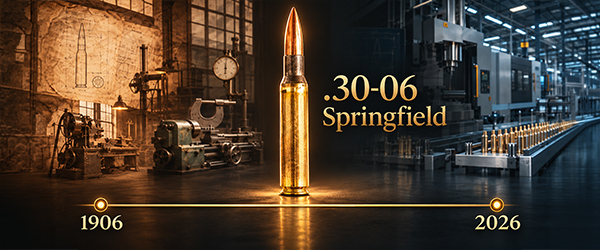
From the dawn of the twentieth century through two world wars, the Cold War and more than a century of civilian sporting tradition, the .30-06 Springfield has witnessed 120 years of technological and industrial transformation.
In 1906, the world looked very different. Electric light was still a luxury in most American homes, and work on the Titanic would not begin for another three years. Theodore Roosevelt was in the White House, months away from receiving the Nobel Peace Prize. In Britain, the launch of HMS Dreadnought, the first "all-big-gun" battleship, made every other battleship afloat obsolete overnight. Across the world, the great powers were racing to modernize their armed forces.
Against this backdrop, the United States Army adopted a rifle cartridge that would become one of the most recognizable names in ammunition history - the .30-06 Springfield.
Few could have anticipated that a cartridge introduced during the age of steam locomotives would remain commercially relevant in the age of artificial intelligence, space exploration and autonomous vehicles.
The journey of the .30-06 is not simply a story about ammunition. It is a story of industrial innovation, international conflict, changing military requirements, sporting traditions and the unusual longevity of a proven engineering design.
The Lessons of 1898
The origins of the .30-06 Springfield can be traced to the Spanish-American War of 1898.
The conflict prompted American military planners to reassess their existing rifles and ammunition. European developments in firearms and smokeless propellants had highlighted the need for modernization.
At Springfield Armory in Massachusetts, engineers began developing a new generation of American service rifles and associated ammunition. Their work resulted in the adoption of the M1903 Springfield rifle and the .30-03 cartridge in 1903.
Ammunition technology was also advancing rapidly. Developments in Europe, particularly Germany's adoption of pointed military projectiles, prompted another review of American ammunition design.
On October 15, 1906, the United States approved a revised cartridge officially designated the Cartridge, Caliber .30, Model of 1906. It would eventually become known as the .30-06 Springfield.
What's in a Name?
Unlike many modern cartridge designations, the name .30-06 contains a historical reference. The ".30" represents its nominal caliber in inches, while "06" refers to the year of its adoption - 1906. Internationally, the cartridge is also known by its metric designation, 7.62×63mm.
Among American ammunition enthusiasts, its name is commonly pronounced "thirty-aught-six". The Springfield designation comes from Springfield Armory, one of the most historically significant institutions in American firearms development.
Interestingly, the name has survived largely unchanged despite more than a century of developments in metallurgy, propellants, manufacturing processes and quality assurance.
Every time someone mentions the .30-06, they are inadvertently referencing an engineering milestone going as far back as Theodore Roosevelt’s presidency.
The First World War: From National Adoption to Global Recognition
The first major chapter in the international history of the .30-06 unfolded during World War I.
When the United States entered the conflict in April 1917, its industrial infrastructure faced the enormous challenge of equipping an expanding military. The .30-06 was already the country's standard military rifle cartridge. Its association with the M1903 Springfield and later, the M1917 Enfield rifle made it a significant part of American military logistics.
The war also showed how much both sides depended on industrial organization.
Standardized specifications, interchangeable components, material availability, inspection procedures and coordination between government arsenals and private manufacturers became essential elements of wartime production.
The experience gained during the conflict influenced American ammunition development and production planning throughout the following decades.
The .30-06 entered World War I as a national military standard. By the war's end, it was recognized well beyond American borders.
The Interwar Years: A New Generation of Engineering
The two decades between the world wars brought rapid advances in mechanical engineering, metallurgy and manufacturing. Automobiles became increasingly affordable, commercial aviation emerged, and assembly-line production transformed entire industries.
Firearms development followed a similar trajectory.
At Springfield Armory, Canadian-born American inventor John Cantius Garand was working on a new generation of service rifles.
After years of research and development, the United States Army officially adopted the M1 Garand in 1936. The transition represented a significant departure from earlier service-rifle technology. Despite the introduction of a substantially different mechanical system, the familiar .30-06 cartridge remained part of the American military inventory.
This continuity illustrates an important aspect of technological evolution: proven standards can stay relevant even when the systems surrounding them undergo fundamental change.
World War II: Powered by Industrial Mobilization
World War II placed the .30-06 Springfield at the center of an unprecedented industrial undertaking.
Ammunition manufacturing was no longer simply a matter of individual craftsmanship. It had become a highly organized discipline in which consistency and standardization were critical.
The human story behind this transformation is just as significant.
As millions of Americans entered military service, women assumed increasingly important roles across the country's manufacturing sector. At Springfield Armory, Women Ordnance Workers (WOWs) became essential to wartime operations. At the height of the war, more than 5,000 of them made up over 40 percent of the Armory's workforce. They contributed to a transformation that extended well beyond military production, challenging traditional assumptions about women's participation in engineering and manufacturing.
That is why the wartime story of the .30-06 is inseparable from the broader history of twentieth-century industrialization and social change.
From World War II to the Cold War
The end of World War II in 1945 did not immediately bring an end to the military career of the .30-06. The cartridge remained in American military service during the Korean War, which began in 1950.
However, the geopolitical landscape was changing. The establishment of NATO in 1949 created new requirements for military standardization among allied countries.
The United States and its allies increasingly explored common ammunition standards to simplify procurement, inventory management and multinational logistics. During the 1950s, the 7.62×51mm NATO cartridge emerged as a new military standard. In 1957, the United States adopted the M14 rifle as the successor to the M1 Garand.
The transition away from the .30-06 happened gradually rather than overnight, with existing equipment and ammunition remaining in service for a long time.
For many military cartridges, such a transition would have marked the beginning of commercial obscurity. For the .30-06, it marked an entirely different chapter.
Beyond the Battlefield: A Civilian Legacy
The civilian history of the .30-06 began long before its military retirement.
During the early twentieth century, American sporting firearms manufacturers incorporated the cartridge into their commercial portfolios. By the interwar period, it had become a fixture of North American sporting culture. Manufacturers such as Winchester, Remington and Savage helped shape its civilian identity through successive models of sporting rifles.
Over time, the .30-06 acquired a cultural identity independent of its original military purpose.
Generations of enthusiasts came to recognize the cartridge not merely as a historical military designation, but as part of the heritage of American sporting firearms. This civilian following helped ensure that the cartridge remained commercially relevant long after its original military role diminished.
A Cartridge That Became a Platform
The .30-06 Springfield holds an important place in the history of cartridge development.
Its case design became the foundation for several later commercial cartridges. Its best-known descendants include the .270 Winchester, introduced in 1925 on the slightly longer case of its .30-03 predecessor; the .280 Remington, introduced in 1957; and the .25-06 Remington, a long-standing wildcat design that Remington standardized in 1969.
The emergence of these related cartridge designs illustrates how a proven design can become a platform for subsequent innovation.
Similar trends can be seen across the history of technological innovation. Like the Ford Model T in automotive manufacturing and the x64 family in microprocessor architectures, the .30-06 occupies a pivotal position in the historical development of commercial rifle ammunition. Its legacy extends beyond the original cartridge to an entire family of engineering concepts that developed around it.
A Century of Manufacturing Transformation
An ammunition factory in 1906 would have looked very different from a modern production facility. Mechanical gauges, conventional machinery, manual inspection and production records maintained on paper characterized much of the early industrial era.
Today, the broader ammunition industry increasingly incorporates technologies such as machine vision, computerized inspection, electronic traceability and automated production monitoring. International technical standards have evolved along with these developments.
Organizations such as the Sporting Arms and Ammunition Manufacturers' Institute (SAAMI) and the Permanent International Commission for the Proof of Small Arms (C.I.P.) provide important frameworks for ammunition standardization and safety.
The inclusion of the .30-06 within modern technical standards shows the continuity of a cartridge introduced more than a century ago, before the First World War.
A New Chapter in India
Engineering know-how often travels across borders and generations. Hughes Precision now manufactures the .30-06 Springfield in India, bringing together a historic American ammunition design and the capabilities of India's state-of-the art ammunition manufacturing industry.
A cartridge originally developed in the USA in the early twentieth century has become part of the wider international ammunition manufacturing landscape. And the international history of the .30-06 Springfield continues to evolve.
The Journey Continues
In the 120 years since the adoption of the .30-06 Springfield, humanity has witnessed two world wars, the emergence of commercial aviation, the nuclear age, the Moon landing, the digital revolution and the rise of artificial intelligence.
Entire industries have appeared and disappeared during its lifetime. Technologies once considered revolutionary have become museum exhibits.
Yet the .30-06 is still in production around the world.
The story of the .30-06 Springfield offers a compelling lesson in engineering: innovation is not always about replacing the old with the new. Sometimes, it is about recognizing the enduring value of an established concept while allowing the technology surrounding it to evolve.
Born in 1906, shaped by history and sustained by more than a century of manufacturing progress, the .30-06 Springfield remains one of the most remarkable chapters in the history of ammunition.
120 years. Two world wars. Generations of technological evolution. And a legacy that continues.
K G Marg, Connaught Place
New Delhi 110 001
Goa 403 722, India