
The Cartridge Case and Rim
Some are straight-walled. Others have bottleneck cases.
-By Sanjay Soni, MD of Hughes Precision Manufacturing
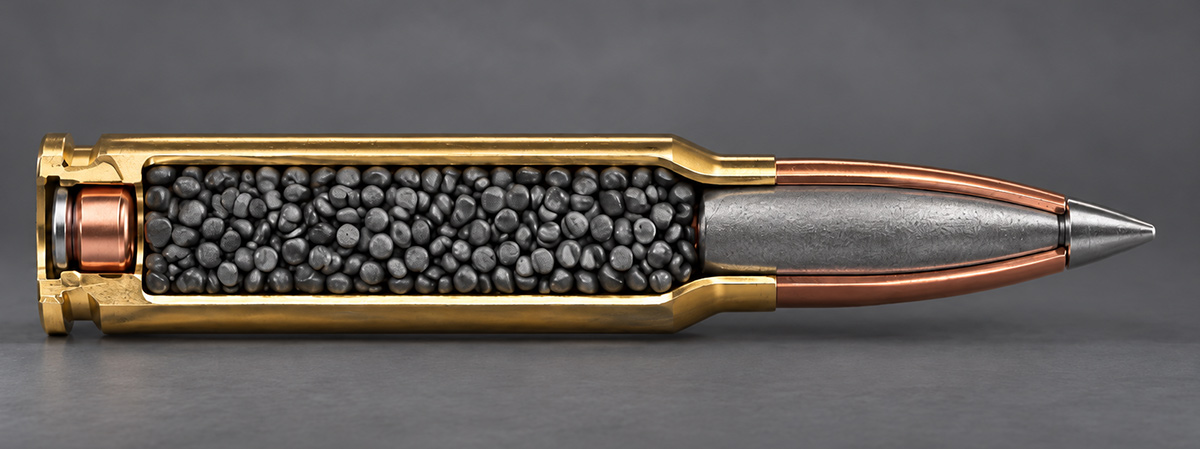
Pick up a cartridge and give it a quick glance. The shiny bullet gets all the attention. The brass case underneath looks almost ordinary, just a little brass container.
But imagine cutting that case open.
Suddenly, it becomes an engineering marvel.
At one end sits the primer, waiting for the pull of the trigger. In front of it are tiny grains of propellant, packed together. Above them, the bullet is held firmly in place.
For most of its life, nothing happens.
The cartridge may spend months in a box, weeks in a magazine, or years stored on a shelf. The powder simply waits.
Then comes one pull of the trigger.
In the time it takes you to blink, the primer ignites and the quiet little brass case is transformed into a pressure vessel. The propellant begins producing rapidly expanding gases, pressure rises, and the bullet starts its journey down the barrel.
And through those extraordinary milliseconds, the cartridge case has several jobs to perform at once.
- It must position the cartridge correctly in the chamber.
- It must contain the enormous pressure.
- When the event is over, it must give the firearm something to grip so the empty case can be ejected.
That is why even the shape of a cartridge case tells a story.
Some are straight-walled. Others have broad bodies that suddenly narrow near the top, giving them their distinctive bottleneck shape.
Bottleneck Cases
Imagine trying to fit a large amount of propellant behind a much smaller projectile. That is essentially the problem the bottleneck cartridge case solves.
Its body is wide enough to provide substantial internal volume, but near the top the case narrows at the shoulder until it reaches the diameter of the bullet.
The result looks a little like a bottle, which is exactly where the name comes from.
This shape became particularly useful in rifle ammunition. Designers could combine a relatively small-diameter projectile with a larger propellant capacity, making the configuration suitable for the higher velocities expected from many rifle cartridges.
Straight-walled Cartridge Cases
Straight-walled cases followed a much simpler path.
Their sides remain almost parallel, rather like a tiny metal drinking glass. That uncomplicated shape works especially well in many pistol and revolver cartridges.
But whichever shape the case takes, something important is waiting at the other end.
The Rim
After a cartridge has fired, the case does not eject out of the chamber by itself. Something has to pull it out.
That is where the rim - or the extractor groove beside it - enters the story.
Think of it as a tiny handle built into the bottom of the cartridge. The firearm's extractor catches that handle and pulls the spent case from the chamber.
On some cartridges, the rim sticks out beyond the body like the brim of a hat. These are rimmed cartridges.
On others, the rim is almost the same diameter as the case body, with a groove cut just above it. These are known as rimless cartridges.
And this small difference helped shape the development of modern firearms.
A protruding rim works extremely well in revolvers and many older designs. A rimless case, on the other hand, stacks neatly in a box magazine and feeds smoothly - one reason it became so common in modern pistols and rifles.
And hidden inside all this geometry is an even more important question:
What actually stops the cartridge from sliding too far into the chamber?
The answer is something called headspace.
That can become the next little chapter of the story.
K G Marg, Connaught Place
New Delhi 110 001
Goa 403 722, India