
Cracking the Caliber Code: What Do the Numbers Really Mean?
Every cartridge has a name - 7.62 × 51 mm, 5.56 × 45 mm, etc. - and every name tells a story.
-By Sanjay Soni, MD of Hughes Precision Manufacturing
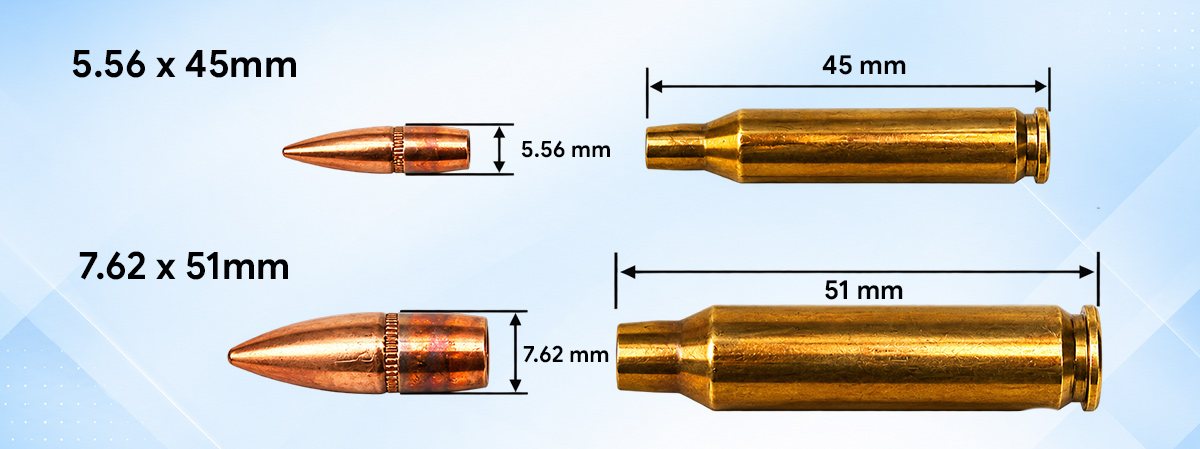
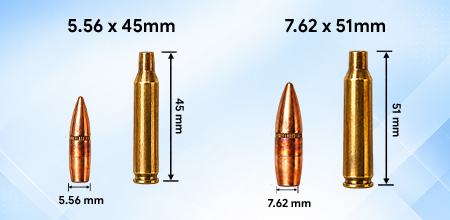
Imagine walking into an ammunition factory. On one table lies a rifle cartridge. Beside it rests another, noticeably smaller and slimmer.
Both have pointed bullets, metallic cases, and remarkably similar shapes. Yet one is considerably larger than the other.
An engineer picks them up and explains - "This one is 7.62 × 51 mm NATO and the other one, 5.56 × 45 mm NATO."
Actually, the numbers describe two important dimensions of the cartridge.
And once you understand them, you will begin to read ammunition names like an engineer.
Meet the Bigger Brother: 7.62 × 51 mm NATO
Let's begin with the larger cartridge.
Its name contains two numbers separated by a multiplication sign. But don't reach for your calculator!
The little × is simply read as "by."
The first number, 7.62 mm, is its nominal caliber, which corresponds to the bore diameter of the gun barrel. The bullet itself is fractionally larger, at about 7.82 mm (.308 in), so that it grips the rifling.
This also explains why the cartridge sits in the .30-caliber family, and yet it is often called .308.
Now for the second number. 51 mm describes the approximate length of the cartridge case, measured from the base to the mouth.
Not the bullet. Not the whole cartridge. Just the metallic case that houses the propellant and holds the projectile.
Put these two measurements together, and the mysterious name suddenly makes sense.
7.62 × 51 mm: nominal caliber × case length.
The 7.62 × 51 mm NATO cartridge has quite a history, too.
Standardized in the 1950s, it went on to serve in conflicts from the jungles of Vietnam to the windswept Falkland Islands.
Even as military forces increasingly adopted smaller cartridges for standard infantry rifles, the 7.62 × 51 mm retained important roles in general-purpose machine guns, designated marksman rifles, sniper systems, and vehicle-mounted weapons.
Now Meet the Smaller Brother: 5.56 × 45 mm NATO
The engineer now picks up the slimmer cartridge.
"This," he explains, "is 5.56 × 45 mm NATO."
Once again, the name tells its own story.
5.56 mm identifies the nominal caliber, belonging to the .22-caliber family, and 45 mm refers to the approximate length of its metallic cartridge case.
Just like its larger brother, the 5.56 × 45 mm uses a bottleneck case, with a wider body narrowing at the shoulder to hold a smaller-diameter projectile.
But why develop a smaller cartridge when a larger one already existed?
Because ammunition design involves making choices.
A larger cartridge is not automatically the best solution for every military requirement.
The 5.56 × 45 mm NATO cartridge offered several advantages for infantry applications: lighter ammunition, lower recoil, and for soldiers, the ability to carry more rounds for the same weight.
The smaller cartridge became widely associated with modern infantry weapons, including the M16 and M4 families, and numerous other military rifles and light machine guns.
It was a different engineering answer to a different operational requirement.
Two cartridges. Two distinct design philosophies. Both remarkable examples of precision engineering.
But Wait. There Is a Third Measurement!
Our engineer places both cartridges on the table again.
"If the 7.62 cartridge case is 51 mm long, and the 5.56 case is 45 mm long, are those also the lengths of the complete cartridges?"
A reasonable question.
But the answer is no.
Remember, the bullet extends beyond the mouth of the cartridge case.
To measure the complete assembled cartridge, we start at the base of the case and continue all the way to the tip of the bullet.
This dimension is called Cartridge Overall Length (COL).
For typical NATO cartridges, the dimensions are approximately:
|
Measurement |
5.56 × 45 mm |
7.62 × 51 mm |
|
Nominal caliber |
5.56 mm |
7.62 mm |
|
Case length |
44.7 mm |
51.2 mm |
|
COL |
57.4 mm |
71.1 mm |
The precise overall length can vary with the bullet design and ammunition specification.
So a cartridge name does not tell us everything about its dimensions. It gives us a useful starting point.
The Numbers Are Only the Beginning
Our two cartridges may appear straightforward from the outside. But look more closely.
Behind their simple names lie extraordinary combinations of chemistry, metallurgy, physics, and precision manufacturing.
Their dimensions help establish their identity. Their internal components, material properties, and manufacturing tolerances help determine their performance.
And despite their differences in size and application, both rely on the same four principal components working together:
- The projectile: The part that leaves the barrel.
- The case: The metallic body that holds the assembly together.
- The propellant: The chemical material that generates the expanding gases.
- The primer: The small component that initiates ignition.
Each has a different responsibility. Each depends on the others.
And all four participate in an extraordinary sequence of events that unfolds in a fraction of a second.
What looks like a simple metallic cartridge is actually a sophisticated engineering system. Even its name has a story to tell.
That is the fascinating thing about ammunition.
K G Marg, Connaught Place
New Delhi 110 001
Goa 403 722, India