
SMALL ARMS PROJECTILES: MORE THAN A “BULLET”
The projectile is where much of the visible engineering comes together.
-By Sanjay Soni, MD of Hughes Precision Manufacturing

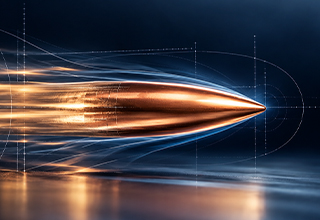
It is the component that leaves the barrel, enters free flight, and ultimately hits the target. Yet the term "bullet” can make the projectile sound simpler than it really is.
In practice, projectile design involves a carefully balanced combination of mass, geometry, materials, jacket construction, base profile, nose shape, and intended terminal behavior.
Two bullets of the same caliber and nominal weight can therefore perform very differently. That difference begins with mass.
Weight Shapes Performance
Projectile weight is conventionally expressed in grains. One ounce equals 437.5 grains, while one gram equals approximately 15.43 grains.
A 55-grain .223/5.56 mm projectile weighs about 3.6 grams. A 168-grain .30-caliber projectile weighs approximately 10.9 grams.
Projectile mass influences:
- Muzzle velocity
- Recoil
- Trajectory
- Wind sensitivity
- Retained energy
- Stability
- Terminal behavior
Lighter projectiles can generally be driven at higher velocities and may offer flatter trajectories over shorter distances.
Heavier bullets, when combined with aerodynamically efficient profiles, can retain velocity and energy more effectively and may offer improved resistance to wind at extended range.
But weight alone never tells the full story.
Projectile length, ballistic coefficient, sectional density, barrel twist rate, muzzle velocity, and construction all contribute to actual performance.
There is no single optimum projectile weight. The correct choice depends on the cartridge, firearm, barrel, range, operating environment, and mission requirement.
Geometry Matters
Projectile shape is one of the defining elements of external ballistics.
The nose profile, ogive, bearing surface, overall length, base geometry, and other design features all influence how the projectile behaves in flight.
Small geometric changes can have increasingly significant consequences as distance increases. That is why two cartridges carrying bullets of identical caliber and weight can produce different velocities, different points of impact, different group sizes, and different aerodynamic performance.
Two of the most important distinctions are found at the rear of the projectile: flat-base and boat-tail designs.
Flat-Base Projectiles
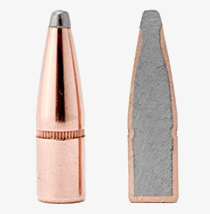
A flat-base projectile terminates in a simple, squared rear surface. The design is straightforward, but highly effective within the right operating envelope.
Flat-base bullets have a long history of strong accuracy at short and intermediate ranges. They remain common in applications where maximum long-range aerodynamic efficiency is not the primary objective.
Depending on projectile length and barrel characteristics, some flat-base bullets may also stabilize effectively with relatively slower twist rates.
Their limitation becomes more apparent as range increases.
A flat base generally generates greater aerodynamic drag than an efficient boat-tail profile. The projectile therefore tends to shed velocity more quickly and becomes increasingly exposed to wind-effects over distance.
It is important, however, not to confuse base geometry with terminal performance.
Penetration, deformation, and weight retention depend far more heavily on jacket design, core construction, impact velocity, and the projectile's intended role.
Boat-Tail Projectiles
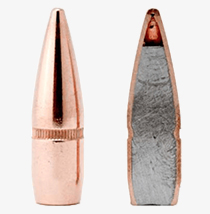
A boat-tail projectile uses a tapered rear section designed to improve airflow as the bullet moves through the atmosphere. The principle is simple - reduce drag and preserve velocity, resulting in:
- Higher ballistic coefficient
- Better velocity retention
- Reduced wind drift
- Improved long-range trajectory
For this reason, boat-tail projectiles are widely used in long-range rifle ammunition.
At short range, the difference may be modest. At extended distance, however, small gains in aerodynamic efficiency can translate into meaningful ballistic advantages.
Very Low Drag Designs
Very Low Drag, or VLD, projectiles take aerodynamic optimization further. These bullets typically combine a long, streamlined nose with a highly efficient rear profile. Their purpose is to reduce drag and preserve velocity over extended distances.
A bullet designed to remain efficient in flight may be constructed very differently from one intended to expand rapidly, retain maximum mass, penetrate deeply, or fragment after impact.
External ballistic efficiency and terminal behavior must therefore be assessed separately.
The Cannelure
A cannelure is a groove or ring formed around the circumference of a projectile. It provides a defined location where the cartridge case is crimped around the bullet, helping to secure the projectile.
Not every projectile uses a cannelure. Many precision-oriented bullets use smooth jackets instead, reflecting a different set of design priorities centred on geometric consistency and projectile uniformity.
Three Projectile Categories
Modern small-arms projectiles include a wide range of specialized designs, but most conventional bullets can be grouped broadly into three categories:
- Ball or full-metal-jacket projectiles
- Expanding projectiles
- Frangible projectiles
Each class is built around a different operating requirement.
Ball Ammunition
The term ball ammunition is historical and can be misleading.
Modern ball ammunition is not generally spherical. In contemporary usage, the term usually refers to general-purpose military-style ammunition, commonly using an FMJ (Full Metal Jacket) projectile.
A typical FMJ bullet consists of a core enclosed wholly or substantially within a harder metal jacket. The jacket improves mechanical integrity, assists reliable feeding, and helps the projectile retain its shape during firing.
These traits have made FMJ ammunition widely used for military applications, training, range use, and high-volume firing.
Conventional FMJ bullets are generally less prone to deformation than expanding projectiles. As a result, they can also penetrate more deeply through certain materials.
Expanding Projectiles
Expanding projectiles are engineered to increase in diameter upon impact when conditions permit. Common designs include soft-point and hollow-point configurations, both intended to produce controlled deformation.
By increasing frontal area, an expanding projectile changes the way it transfers energy and penetrates the target medium.
Different designs may prioritize:
- Rapid expansion
- Controlled expansion
- Deeper penetration
- High weight retention
The performance of expanding projectiles depend on multiple variables including impact velocity, nose geometry, jacket thickness, core design, bonding methods, and target medium. This is why it is difficult to treat expanding ammunition as a single, uniform category.
Frangible Projectiles
Frangible ammunition follows a different design philosophy. Instead of remaining intact after impact with a hard surface, frangible projectiles are designed to break into smaller particles. Their principal purpose is to reduce the risks associated with ricochet and splash-back in. This makes frangible ammunition relevant to certain military, law-enforcement, and specialist training applications.
Frangible projectiles are produced from compressed copper, copper alloy, or other powdered-metal materials.
The term "frangible,” however, should never be interpreted as "safe” or "low risk.” Until the projectile encounters the conditions to break apart, it remains live ammunition and must be treated accordingly.
Every Projectile Is a Compromise
Projectile design is ultimately an exercise in balancing competing requirements.
A bullet optimized for long-range aerodynamic efficiency may require a different geometry from one designed for controlled deformation. A military projectile expected to withstand transport and rough handling may incorporate features that are unnecessary in a precision competition round.
Design engineers must balance:
- Mass
- Length
- Aerodynamic efficiency
- Structural strength
- Stability
- Terminal performance
- Manufacturing consistency
- Firearm compatibility
- Mission requirements
This is why caliber and weight alone reveal relatively little about a projectile's true performance envelope.
More Engineering Than Meets the Eye
In modern ammunition engineering, the bullet is not simply the component that leaves the barrel. It is the final expression of the cartridge's intended performance.
Its geometry governs how efficiently it moves through the atmosphere. Its mass influences velocity, recoil, trajectory, and retained energy. Its construction determines how it behaves on impact. Its base profile affects drag, while seemingly minor features such as a cannelure can contribute to cartridge integrity.
There is therefore no universally superior projectile design, only a design better suited to a particular role.
K G Marg, Connaught Place
New Delhi 110 001
Goa 403 722, India